
The Power of Pricing Psychology
Which Would You Choose?
To illustrate a point, let’s assume we all enjoy vodka, and we can all agree on one of the options above.
Now, picture yourself standing in the liquor aisle at Costco. Your eyes scan the shelves and land on two bottles.
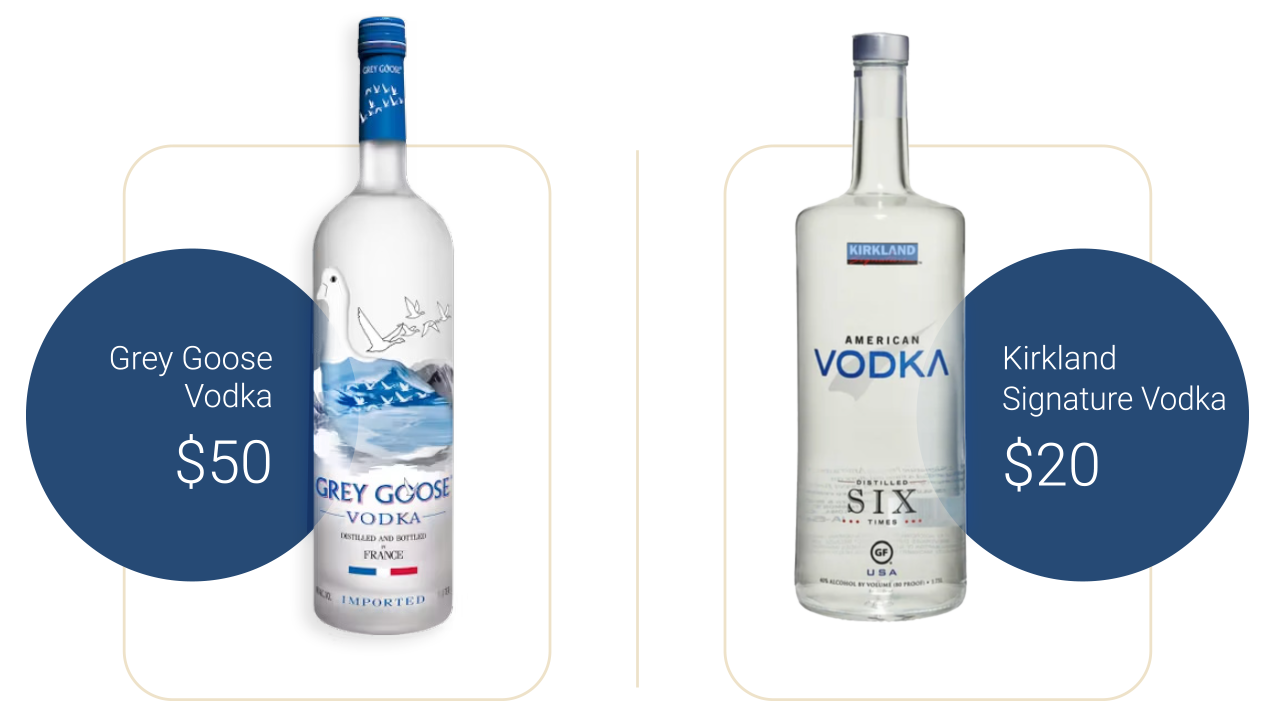
On the left, Grey Goose. Sleek, frosted glass. Elegant design. A quiet air of sophistication. Price: $50.
On the right, Kirkland Signature, Costco’s house-brand vodka. Same French origin. Sourced from the Cognac region. Gluten-free. Distilled with similar precision. Price: just $20.
You pause, weighing your options.
Then, almost instinctively, you reach for the Grey Goose. But why?
The Psychology Beneath the Pour
Perceived Value vs. Actual Value
Both vodkas may be virtually indistinguishable in quality, but they’re not selling the same thing.
Grey Goose sells status. It’s aspirational. It’s what you bring to a rooftop soirée.
Kirkland sells value. It’s practical. It’s what you pick for a weekend barbecue.
This is the price-quality heuristic in action: the deeply rooted belief that expensive equals better. Even when no empirical evidence supports it, our minds make that leap instantly.
Emotional Triggers in Every Sip
Purchase decisions aren’t purely transactional, they’re emotional.
Pouring Grey Goose feels rewarding. A brand like Grey Goose doesn’t just enter the glass, it enters the story of the evening. Serving Kirkland might feel... cautious, even defensive. What we drink says something about who we are or who we want to be:

Biases That Shape the Cart
Our brains are wired for shortcuts. These mental heuristics guide our choices, especially under uncertainty:
Confirmation Bias: If you believe expensive vodka tastes better, you’re likely to experience it that way even in a blind test.
Social Proof: Grey Goose is seen in movies, music videos, and influencer posts. Kirkland... not so much. Visibility equals legitimacy.
From Vodka to Voice-of-the-Market
This vodka aisle scenario is not unique; it’s a daily reality for B2C and B2B businesses alike. Product teams and marketers must recognize that pricing isn’t just a financial lever, it’s a psychological one. The decision to buy is rarely rational. It’s emotional, intuitive, and influenced by subtle cues.
Understanding why people choose Grey Goose over Kirkland, even when the ingredients are often indistinguishable, isn’t just a curiosity. It’s a masterclass in psychological pricing, a concept every product professional should place alongside their market understanding when making pricing decisions.
Pricing Isn’t Just a Number, It’s a Message
The price of your product communicates quality, intention, identity, and even aspiration. When you set a price, you’re influencing not just purchase behavior, but perception. This is especially powerful in competitive markets, where differences in utility are marginal but differences in perceived value are massive.
Like the vodka aisle, your product might sit next to competitors with similar features, functions, or benefits. What sets it apart?
Are you pricing to reflect status and exclusivity or access and efficiency?
Does your price suggest this is a “premium experience,” or a practical tool?
What emotions does your price trigger: pride, safety, ambition, guilt?
There may be times that you want to leverage this and be the Costco option. But having basic psychological understanding of your audience’s preferences enables you to position your products where they are. That means you can be Grey Goose when that fits your strategy, or Kirkland, when accessibility and volume are more aligned with your goals. What matters is making that choice with intent, grounded in market insight.
Why It Matters
Product managers and marketers aren’t just designing offerings, they’re shaping experiences and influencing human behavior. Whether pricing enterprise software, subscriptions, or physical goods, the principles remain the same: people don’t buy just based on logic—they buy based on emotion, context, and perception. Strategic pricing taps into these forces. And when you align pricing psychology with customer insight, product differentiation, and positioning—you unlock both revenue and resonance.
SIDEBARThe Importance of Differentiation
There’s a long-running myth that Grey Goose and Kirkland vodka are secretly the same.The rumor became so widespread that Grey Goose publicly refuted it because they understood what’s at stake.
That’s the power of differentiation. It’s not just marketing fluff, it’s survival. When products start looking and sounding the same, price becomes the only weapon left. And let’s be honest, no one wants to win the “cheapest option” race.
Product pros, take note: even if two offerings solve the same problem, the one with the clearer, stronger identity usually wins. Differentiation builds value, attracts loyalty, and protects your margin. Without the fancy bottle and prestige, Grey Goose becomes… well, just a goose.
-
Downloadable content featured on pragmaticinstitute.com.
Targeted to product professionals that have a stake in the pricing of their products.